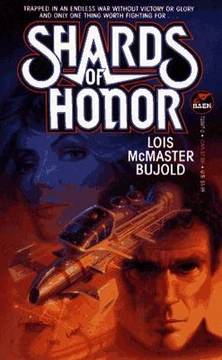
The Vorkosigan estate
A modest home in a world of emperors, where family outlasts rank.

The Vorkosigan estate is the family holding of the Vorkosigan minor house on Barrayar, the homeworld of Lois McMaster Bujold's sprawling science-fiction saga. It is not a sprawling domain or a military fortress but a modest, lived-in family property that anchors the personal and political lives of one of the saga's most beloved families. Where the great houses of Barrayar command vast territories and political leverage, the Vorkosigan estate is a place of quiet pride, familial duty, and the constant awareness of one's smallness in a world ruled by emperors and warlords. The estate serves as the emotional and narrative bedrock for Count Piotr Vorkosigan's household, the upbringing of his children Aral and Bethke, and the broader exploration of what it means to be a minor noble in a society that rewards power and punishes weakness. It is the place from which Aral departs into military service, to which he returns between campaigns, and where the family's bonds are tested by politics, disability, and the ever-present shadow of Barrayar's autocratic regime.
- Location
- Barrayar
- Type
- Minor noble house estate
- Head of House
- Count Piotr Vorkosigan (retired officer)
- Notable Residents
- Aral Vorkosigan, Bethke Vorkosigan
- Political Standing
- Lower-tier nobility; no significant territorial or military claims
- First Referenced
- Shards of Honor (1986)
Lore & Background
In the rigid hierarchy of Barrayaran nobility, the Vorkosigan estate occupies a place of quiet dignity. The family's title is that of Count, a rank that places them firmly in the nobility but far below the great ducal and comital houses that dominate the court at Comstar. Their holding is a family home and surrounding lands, sufficient to sustain a household but carrying no independent military garrison or significant economic power. This modesty is not a source of shame to the Vorkosigans; it is simply their reality, and Piotr raises his children with an emphasis on competence, loyalty, and personal integrity rather than the accumulation of political capital. The estate is the site of some of the saga's most tender and painful family moments. It is where Bethke, Aral's younger sister, lives with the physical limitations of her condition, a fact that shapes the family's dynamics and Aral's protective instincts in ways that echo through his adult life. It is where Piotr, a retired officer who served Barrayar's military with quiet devotion, maintains a household that is a small island of stability in a political sea of shifting alliances and imperial caprice. The walls of the estate have witnessed arguments, reconciliations, quiet grief, and the slow accumulation of a family's shared history. Politically, the estate's significance is largely negative: it marks the Vorkosigans as a family that can be overlooked, pressured, or absorbed by larger powers. This vulnerability is a recurring theme, as the family's minor status means they must navigate Barrayar's treacherous court life without the buffer of a large retinue or territorial leverage. Yet it is precisely this lack of grandeur that makes the Vorkosigan estate a counterpoint to the saga's grander settings—a reminder that the human story, the family story, is the engine beneath the political and military spectacle.
In Their Own Story
The evening light came in low and amber through the tall windows of the Vorkosigan drawing room, catching the dust motes that drifted in lazy spirals. Piotr stood by the window with his hands clasped behind his back, watching the last of the sun sink behind the tree line that marked the edge of the estate's grounds. The house was quiet in the way it was always quiet when the children were away—Aral off to whatever duty the military demanded, Bethke in her own rooms where the afternoon light fell differently, where the world was smaller and more manageable. He did not mind the silence. He had lived in this house for decades, and its rooms knew the particular rhythm of his footsteps, the way the floorboards creaked at the third step from the door, the faint smell of pipe tobacco that had seeped into the curtains over years. It was not a grand house. It would never be a grand house. But when the door opened and the particular cadence of Aral's stride came up the stairs—slightly uneven, a little faster than necessary, as if he were still half-expecting to be summoned to a briefing—Piotr felt the old, steady warmth of a son coming home. "Father." Just that. No report, no politics, no performance. Just the sound of a man setting down the weight of the world at the threshold of a small, imperfect house, and being, for a few hours, simply a son again.
Reader's Guide
The Vorkosigan estate is a modest noble holding on Barrayar, the feudal-technological homeworld at the center of the saga. Physically, it is a family residence and surrounding grounds—functional, well-kept, but not ostentatious. It lacks the grandeur of the great houses' estates or the military infrastructure of a garrison town. Its architecture and furnishings reflect a household that values comfort and order over display, consistent with Piotr's background as a retired military officer who has seen enough of grandeur to prefer the simple. Politically, the estate marks the Vorkosigans as minor nobility. They hold the rank of Count but possess no significant territorial claims, no standing military force, and no major role in Barrayar's court politics. This makes them vulnerable to the machinations of more powerful houses and to the arbitrary whims of the Emperor, a vulnerability that drives much of the family's narrative tension. Their status is secure enough to be respected but precarious enough to require constant, low-level vigilance. The estate is the home base for Count Piotr, his son Aral (a career military officer whose assignments take him across Barrayar and beyond), and his daughter Bethke, whose physical condition anchors her to the household. It is the place from which Aral departs for service and to which he returns, and it is the setting for the family's private dramas that underpin the saga's larger political and military conflicts. In terms of connections, the estate links to Comstar (the capital, where court politics unfold), to military installations and campaign sites where Aral serves, and to the broader network of Barrayaran noble houses. It is a node in the family web that extends into the wider saga, particularly as Aral's marriage and political entanglements draw the estate into conflicts far beyond its modest walls.
Did You Know?
- The Vorkosigan estate is a deliberate narrative contrast to the grand, politically powerful holdings of Barrayar's major houses, emphasizing that the saga's emotional core lives in a small, imperfect home rather than a p
- Bethke Vorkosigan, Aral's sister, lives at the estate with a physical condition that limits her mobility, and her presence shapes the family's dynamics and Aral's character in ways that resonate throughout the saga.
- Count Piotr Vorkosigan is a retired military officer, and the estate reflects his background: orderly, practical, and free of the political posturing that characterizes more ambitious noble households.
- The Vorkosigan family's minor status means they lack the political buffer of great houses, making them vulnerable to the machinations of Barrayar's court and the Emperor's arbitrary power—a source of tension in multiple
More in World & Setting
Elsewhere in the Vorkosigan Saga universe
Spotted an error? Know more?
This is a living reference — every entry is fact-audited, and reader corrections feed straight into our audit queue. Suggest an edit · See this site's audit record