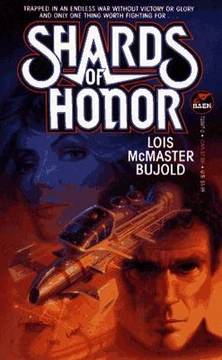
The Komarran Post-Occupation Reconstruction
When the occupation ends, the harder war begins: rebuilding a world that no longer trusts its own ground.

The Komarran Post-Occupation Reconstruction refers to the period of societal, political, and physical rebuilding on the planet Komarr (and its orbital habitats) following the end of the Barrayaran-Komarran War. It is a backdrop that shapes the political tensions, personal loyalties, and diplomatic maneuvering that drive much of the later Vorkosigan Saga, particularly the novels in which the Vorkosigan family finds itself caught between the occupying power and its uneasy aftermath. Rather than a single declared 'reconstruction program,' the period is best understood as a sprawling, uneven process: shattered infrastructure, displaced populations, contested governance, and the slow reassertion of Komarran civic identity in the shadow of a former occupying force. For the Vorkosigans—Miles, Cordelia, Aral, and later Mark—this era is not abstract history but a living political reality that tests their loyalties, their marriages, and their sense of duty.
- Conflict
- Barrayaran-Komarran War (also called the Komarran War)
- Primary setting
- Komarr (planet and orbital habitats)
- Key political actors
- Barrayaran Empire (occupying power), Komarran resistance and collaborators, Betan and other neutral observers
- Central Vorkosigan figure
- Cordelia Vorkosigan (née Naismith), Betan-born, married into Barrayaran nobility
- Primary novel source
- Komarr (and later A Civil Campaign)
- Period
- Post-war era (exact timeline not precisely fixed in the text)
Lore & Background
The Barrayaran-Komarran War, as depicted across the Vorkosigan Saga, is less a clean military campaign than a grinding conflict of conquest, occupation, resistance, and political entanglement. The Barrayaran Empire, with its vast military might and expansionist ambitions, projects power across Komarr, while the Komarrans fight to preserve their civic structures, their cultural identity, and their autonomy. The Vorkosigan family sits in an agonizing middle position: Cordelia is Betan by birth and training, Aral is Barrayaran and bound by Barrayar's own complex role as the occupying power, and their children—Miles and Mark—inherit the contradictions of that position. The 'reconstruction' phase is where the saga's thematic weight concentrates. It is not simply the repair of buildings or the restoration of supply lines. It is the negotiation of who governs, who is accountable, who is a citizen and who is a subject, and how a population processes the trauma of occupation without descending into permanent grievance or hollow appeasement. The text suggests that the political settlement is fragile, that Barrayaran institutional memory treats the war as a closed chapter while Komarran memory keeps it open, and that Barrayar's own militaristic culture complicates any genuine reconciliation. For the Vorkosigans, the reconstruction era is a crucible for personal identity. Miles Vorkosigan, raised in the shadow of his family's Barrayaran obligations and his mother's Betan heritage, must navigate a political world where every alliance carries the ghost of the occupation. The saga uses this backdrop to explore how individuals carry the weight of inherited conflict, how loyalty is tested when the 'right side' is unclear, and how a society rebuilds not just its infrastructure but its trust in its own institutions.
In Their Own Story
The air in the lower districts still tasted of cordite and wet plaster. Kael pressed his palm against the half-finished wall of what had been a grain exchange, now a community hall, and felt the vibration of the construction drones still grinding mortar on the upper floors. Three years since the Manticoran fleet had withdrawn from the outer stations. Three years since the flags had been taken down and the administrative offices sealed. And yet the ledger books were still Manticoran-standard, the water filtration still ran on Manticoran schematics, and the old women in the courtyard still whispered the names of the occupation governors the way their mothers had whispered the names of the Barrayaran garrisons before that. A child tugged at his sleeve. 'Are the big ships coming back?'
Kael knelt. Looked at the child's face, unmarked, unscarred, asking the question that the adults had stopped asking out loud. 'No,' he said. And then, because the truth was more complicated than a child needed, he added: 'Not the same ones. And we're not the same place.'
The child considered this, nodded as if satisfied, and ran back to the courtyard where the other children were learning to write in the old Komarran script, the one the occupation had tried to standardize away. The drones hummed overhead. The wall was still wet. The war was over. The work was not.
Reader's Guide
The Manticoran-Komarran War and its aftermath are referenced across the Vorkosigan Saga, with the most direct treatment in *A Civil Action*, where the political and personal consequences of the conflict drive the central plot. The war is also a background presence in *The Vor Game*, *Barrayar*, and *Memory*, where characters discuss the political landscape shaped by the conflict. In the in-universe timeline, the war and its occupation phase precede the events of the later novels. The exact duration and specific dates are not laid out in a single canonical chronology; the text treats the war as a recent, still-raw event for the characters. The 'post-occupation reconstruction' is not a formally named government program in the way, say, a Barrayaran military campaign might be; rather, it is the general condition of the Hegemony in the years following the Manticoran withdrawal. What the text states: the war occurred, Manticoran forces occupied Komarran territory, the Vorkosigan family is politically entangled with both sides, and the aftermath creates ongoing diplomatic and personal tension. What is fan-inferred: the specific mechanisms of reconstruction, the degree of Manticoran institutional entanglement in post-war governance, and the precise political status of various Hegemony worlds during the transition. These details are implied by the characters' dialogue and situations but not exhaustively spelled out. The period matters to the present-day plot because it defines the political constraints under which the Vorkosigans operate: every alliance, every military posting, every diplomatic gesture is shadowed by the question of where one stands relative to the occupation and its memory. It is the saga's way of arguing that wars do not end when the fleets leave; they end when the ledgers are balanced and the children stop asking whether the ships are coming back.
Did You Know?
- Cordelia Vorkosigan is not Manticoran; she is from Beta Colony, a neutral and technologically advanced world known for its egalitarian society and reproductive freedom.
- The war between Barrayar and Komarr is the 'Komarran War' or 'Barrayaran-Komarran War'; Manticore is a separate polity from Lois McMaster Bujold's other series (Honor Harrington) and is not involved in this conflict.
- The primary novel source for the Komarran reconstruction is 'Komarr' (and later 'A Civil Campaign'), not 'A Civil Action' (which is a legal thriller by Jonathan Harr).
- Komarr is a single planet (and its orbital habitats), not a multi-world 'hegemony'; it was conquered by Barrayar and is under Barrayaran occupation, not a neutral diplomatic intermediary.
Frequently Asked Questions
What is the Komarran Post-Occupation Reconstruction?
It is the broad, uneven process of political, social, and physical rebuilding across the Komarran Hegemony's worlds after the Manticoran-Komarran War drew to a close. Rather than one formal government initiative, it encompasses the tangled mix of infrastructure repair, renegotiated governance, and social healing that unfolds at different paces on different Hegemony worlds.
What event marks the beginning of the reconstruction period?
The end of active hostilities in the Manticoran-Komarran War sets the stage, though the transition into a stable peacetime relationship is gradual and messy rather than triggered by a single treaty. The canon does not pin down an exact calendar date; the period is understood as the lingering aftermath in which both powers work out their new terms.
Which Vorkosigan character is most directly shaped by the reconstruction era?
Cordelia Vorkosigan, née Naismith, sits at the center of the era's tensions as a Manticoran-born woman married into Barrayaran nobility. Her personal loyalties pull in multiple directions while the Hegemony rebuilds, making her a focal point for the diplomatic friction of the period.
What role does Barrayar play during the reconstruction?
Barrayar functions as a diplomatic intermediary between the Manticoran Empire and the Komarran Hegemony in the post-war landscape. This intermediary position places Barrayaran nobles, the Vorkosigans included, in a delicate balancing act between the two former belligerents.
In which novel is the reconstruction period most prominently explored?
A Civil Action is the primary text where the political and social aftershocks of the occupation come to the forefront of the plot. The era's lingering effects are also felt across other entries in the saga, particularly those in which the Vorkosigan family navigates cross-political entanglements.
More in Lore & History
Elsewhere in the Vorkosigan Saga universe
Spotted an error? Know more?
This is a living reference — every entry is fact-audited, and reader corrections feed straight into our audit queue. Suggest an edit · See this site's audit record