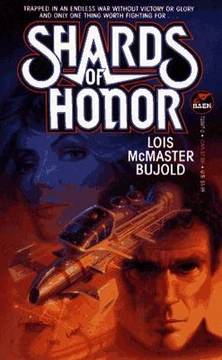
The Vorkosigan Family
Great house, stubborn hearts, and a loyalty that outlasts empires.

The Vorkosigan family is one of the most powerful Count's houses of Barrayar, later deeply entangled in the politics of the planet, whose members are bound together by a fierce, sometimes stubborn loyalty and a shared tradition of military service. Across the Vorkosigan Saga, the family endures tragedy, political upheaval, and the personal costs of duty, yet consistently reconstitutes itself around its core: the people they love and the promises they keep to one another. From Count Piotr's generation through the stewardship of Aral, the mothering of Cordelia, and the turbulent, brilliant lives of Miles and Ivan, the Vorkosigans function as both a lens and an engine of the wider story. Their personal dramas—marriages, betrayals, losses, and hard-won reconciliations—mirror the larger conflicts between Barrayar's autocratic traditions and the democratic values of Beta Colony and the wider galactic community.
- Notable members
- Piotr, Aral, Cordelia Naismith, Miles, Ivan Vorpatril
Lore & Background
The Vorkosigans trace their prominence to a long line of Barrayaran military officers, and by the time the saga opens, the family's reputation rests less on wealth or political clout than on a kind of unshakeable personal integrity. Count Piotr Vorkosigan, a decorated officer, embodies the older Barrayaran ideal of the warrior-noble: proud, direct, and quick to violence when his honor or his family is threatened. His son Aral Vorkosigan carries that legacy into a more complicated era. Aral's marriage to Cordelia Naismith, a Betan Survey captain, ties the Vorkosigans to off-world perspectives, and his eventual assumption of the Count's title makes him the family's public face during a period of political transformation. Yet it is the private architecture of the household—Cordelia's fierce protectiveness, the complicated love between cousins and half-cousins—that defines the family's true character. Miles Vorkosigan, the small, damaged son who becomes the saga's central figure (his physical condition a result of in utero exposure to a teratogenic gas during an assassination attempt on his father), inherits the family's stubbornness and its capacity for self-sacrifice, channeling them into a life of espionage, diplomacy, and reluctant heroism. His cousin Ivan Vorpatril, son of Alys Vorpatril and Padma Vorpatril, represents the family's other face: the open, exuberant, and unexpectedly competent soldier. Together, the Vorkosigans form a tapestry of grief, humor, and an almost irrational devotion to one another that no political faction can replicate.
In Their Own Story
The kitchen table at Vorkosigan Hall was scarred with decades of knife marks and coffee rings, and the chairs were mismatched the way they always had been. Alys sat at the head, her hands wrapped around a cup she hadn't finished, watching her two sons argue about something trivial—whether the new posting was a promotion or a punishment. Miles was being precise, cutting the air with his fingers. Ivan was being loud, slamming his palm flat on the wood, grinning. Cordyna, passing through with a tray of bread, set it down without a word and poured a third glass of wine, sliding it toward Miles. He looked up. She looked away. Outside, the Barrayaran wind rattled the shutters, and somewhere in the house a clock that had ticked for forty years kept its indifferent count. Alys refilled her cup. The argument resumed. Nobody left the table.
Reader's Guide
The Vorkosigan family functions as a minor noble house whose primary purpose is the preservation of its members and the continuation of its name. Leadership passes through the Count's line: Piotr held the title in the earlier generation, Aral assumed it and governed the family's public affairs, and Miles, as Aral's son, stands as the next heir. Alys, though not the Count's wife in the formal sense, is the emotional and practical center of the household, and her authority within the family is absolute. Internal culture is defined by fierce loyalty, a wry and self-deprecating humor, and an expectation that members will endure hardship without complaint before seeking help. The family bonds are complicated by Alys's first marriage to Droushnakovi and the resulting half-sibling relationship between Ivan and Miles, a tension that never fully resolves but is always acknowledged with love. Key members include [Piotr Vorkosigan], [Alys Vorkosigan], [Aral Vorkosigan], [Cordyna Vorkosigan], [Kareen Suv Vorkosigan], [Miles Vorkosigan], [Ivan Vorkosigan], and [Etean Vorkosigan]. Their principal alliance is with the Suv house through Kareen's marriage, which elevates the Vorkosigans politically. Rivalries are less with a single faction than with the broader Barrayaran political establishment, whose machinations repeatedly threaten the family. Across the saga, the Vorkosigans evolve from a traditional military household into a family shaped by interstellar politics, genetic ethics, and the slow dismantling of autocratic power, yet their internal code—protect your own, keep your word, laugh when you can—remains constant.
Did You Know?
- The Vorkosigan family's internal dynamics are shaped by Ivan Vorpatril being Miles's cousin rather than half-brother, a fact that colors every family interaction.
- Cordelia Naismith's marriage to Aral connects the powerful Vorkosigan house to Beta Colony, dramatically altering the family's political and cultural standing.
- Miles Vorkosigan's physical smallness and brittle bones are a result of soltoxin poisoning intended for his father, Aral, not his mother.
The Vorkosigan Family at the Center
The Vorkosigan Saga orbits around a single extended family whose members span multiple worlds and political systems. Miles Vorkosigan, the protagonist of most novels, is the son of a Betan former ship captain, Cordelia, and a Barrayaran aristocrat father. His twin brother Mark is a clone, while Miles himself is physically disabled—a contrast that runs through their stories. Their cousin Ivan Vorpatril adds another layer of family dynamics. The point-of-view cast extends well beyond the Vorkosigans: women like Cordelia and Ekaterin anchor several novels, a gay man named Ethan of Athos carries his own arc, and supporting figures such as bodyguard Roic, family friend Kareen Koudelka, and the runaway Jin round out the ensemble. This deliberate diversity of perspective—spanning gender, sexuality, ability, and even biological origin—gives the saga a breadth that few science fiction series of its era attempted.
A Galaxy of Divergent Worlds
Humanity has spread across dozens of colonized planets over centuries, developing sharply divergent cultures in the absence of any competing intelligent species. Barrayar's history is particularly dramatic: its original wormhole collapsed, severing contact with the rest of the galaxy and triggering a Time of Isolation. During that period, apparent nuclear warfare left vast regions radioactive, genetic diversity plummeted, and mutagenic compounds in native plants bred a deep cultural phobia of mutation that hardened into xenophobia. Barrayar was eventually rediscovered through a wormhole jump from Komarr, and its reconnection set the stage for conflict with the Cetagandan empire, which used Komarr's wormhole to conquer Barrayar before Barrayar ultimately defeated its conquerors. Interstellar travel itself relies on spatial anomalies—wormholes creating tunnels in five-dimensional space—typically bracketed by military, commercial, or independent space stations. The political landscape ranges from corporate democracies and criminal-corporate rule to monarchies, empires, and direct democracies, with most planets governed by a single dominant authority.
Technology, Medicine, and the Limits of Progress
Bujold grounds her far-future setting in recognizable 20th-century engineering, projected into zero-gravity and alien-solar-system contexts. Biomedical technology is especially prominent: cloning, artificial wombs called uterine replicators, and cryochambers that preserve and revive the recently deceased all feature heavily. Yet the series also interrogates the human cost of technological obsolescence. Two jump pilots with outdated navigational brain implants and several genetically engineered characters find themselves psychologically stranded when the programs that defined them are terminated. Computing has moved beyond paper to plastic sheets and electronic devices, with characters carrying wristconsoles and personal comconsoles, while two-dimensional video gives way to three-dimensional holograms. Interstellar communication, however, remains painfully constrained: messages must be recorded on physical discs transported through wormholes at great cost, relayed between stations by shipboard systems. Military technology spans plasma rays, gravity-manipulation attacks, combat suits, needlers, nerve disruptors, and even bioweapons like wide-spectrum toxin bombs and race-targeting genetically modified microbes. A truth serum called fast-penta is a standard interrogation tool, though characters have devised defenses ranging from induced fatal allergies to genetic immunity.
Literary Legacy and Thematic Ambition
Spanning from 1986 to May 2018, the Vorkosigan Saga has earned five Hugo Award wins, including one for Best Series, cementing its place among the most decorated science fiction series of its era. Lois McMaster Bujold uses the setting as a lens on contemporary politics, most visibly through the contrast between the technology-rich, egalitarian Beta Colony and the heroic, militaristic, hierarchical society of Barrayar, where personal relationships are essential to societal continuity. Bujold has acknowledged that her universal timekeeping system—a standard measure applied across all planets regardless of day or year length—is a deliberate storytelling convenience rather than a technologically or economically feasible arrangement. The saga's ambition extends to exploring how cultures adapt to their environments, as seen in Falling Free and Diplomatic Immunity, which examine the friction between a gravity-free society and one dependent on gravity. With ongoing colonization efforts like the settlement of Sergyar, the universe remains in motion even as its central family grapples with identity, duty, and belonging.
Frequently Asked Questions
Who are the Vorkosigans in the Barrayar / Miles Vorkosigan Saga?
They are a minor noble house originally from Comstar that became inextricably tied to Barrayar through marriage, military service, and political entanglement. Their most prominent members span three generations: Count Piotr and his wife Alys, the widowed Count Aral, and their children Miles and Ivan.
What role does the Vorkosigan family play across the books?
They anchor nearly every major plotline, from the Barrayaran succession crisis to Miles's diplomatic and military career, linking Comstar, Barrayar, and the wider universe through personal relationships and inherited duty. Their small-house perspective gives readers an intimate, human-scale lens on events that otherwise play out on a galactic level.
How does the Vorkosigan family's story end?
By the final novels the family has weathered multiple deaths, coups, and interplanetary conflicts, and settles into a quieter era largely under Miles's stewardship. The saga closes with them intact but deeply changed, still bound by the same stubborn loyalty and dry humor that defined them from the first page.
Why are the Vorkosigans important to the Vorkosigan Saga?
They are Bujold's primary vehicle for examining duty, grief, and the personal cost of political power across a lifetime. Their deliberately low-ranking status makes their resilience and sense of honor stand out sharply against the vast machinery of Barrayaran and Comstar politics.
What makes the Vorkosigan family distinctive compared to other noble houses?
A fierce, sometimes maddening loyalty to one another, a long tradition of military service, and a self-deprecating wit they deploy even in the worst moments. Rather than seeking power for its own sake, they consistently reconstitute around the people they love and the promises they have made to each other.
More in Factions & Groups
Elsewhere in the Vorkosigan Saga universe
Spotted an error? Know more?
This is a living reference — every entry is fact-audited, and reader corrections feed straight into our audit queue. Suggest an edit · See this site's audit record