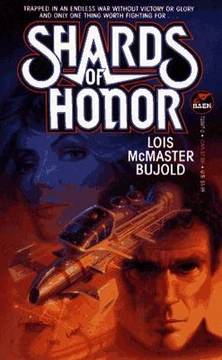
The Vorkosigan Family's Rise from Minor Nobility
From major Counts to the heart of Barrayar's power: the Vorkosigan legacy of service and command.

The Vorkosigan family's ascent from a respected Barrayaran noble house to one of the most politically consequential dynasties in the Barrayaran Empire is one of the saga's central historical threads. Beginning as a major Count's line with a proud and storied military tradition, the family's fortunes were transformed across several generations of service—culminating in Aral Vorkosigan's assumption of the Regency over Barrayar and the reshaping of the planet's political landscape. This entry traces the broad arc of that rise: the feudal context of Barrayar, the family's military ethos, the pivotal Cetagandan invasion and Escobaran War eras, and the way a single Regent's decisions elevated the Vorkosigans from powerful Counts to the de facto power brokers of an entire world. It is a story told in fragments across the novels, pieced together by characters' memories, family letters, and the quiet weight of inherited duty.
- Family
- Vorkosigan
- Noble Rank
- Count (Barrayaran feudal system, major house)
- Homeworld
- Barrayar (Barrayaran Empire)
- Key Era
- Cetagandan invasion and its aftermath
- Notable Member
- Aral Vorkosigan – Regent of Barrayar; Piotr Vorkosigan – powerful Count and key military leader
- Family Tradition
- Military service and loyalty to the Barrayaran crown
- Saga Span
- Referenced across multiple novels from Shards of Honor onward
Lore & Background
In Barrayar's rigid feudal hierarchy, the Vorkosigans occupied a position of considerable power and respect. They were a major Count's house—military-minded, honour-bound, and deeply committed to the planet's traditions—standing among the great houses whose names carried the weight of centuries of political marriage and territorial control. Piotr Vorkosigan, Aral's father, embodied this ethos: a powerful Count and key military leader whose life was defined by service and command, whose pride lay in his men and his duty rather than in courtly intrigue. The Cetagandan invasion shattered Barrayar's isolation and forced every noble house to prove its worth in the crucible of total war. The Vorkosigans, like many military families, threw themselves into the defence of their world. Aral Vorkosigan served as an ensign during the Cetagandan invasion—his first combat—and later as a lieutenant during the Escobaran War, experiences that shaped his later political instincts and his deep understanding of what war cost ordinary people. It was during and after these conflicts that the family's standing shifted decisively. The Emperor's death and the resulting succession crisis created a power vacuum that the existing great houses were ill-equipped—or unwilling—to fill. Aral, by virtue of his competence, his integrity, and his willingness to do the unglamorous work of governance, was thrust into the Regency. The family's rise was not a single dramatic coup but a slow accumulation of trust. Each generation of Vorkosigan officers who served well, who kept their word, who put Barrayar's survival above personal ambition, added another layer of legitimacy. By the time Aral sat as Regent, the name Vorkosigan carried a weight that no amount of ancestral land could purchase. The great houses, who had once stood alongside the Vorkosigans, now found themselves dependent on a family whose authority rested not only on bloodline prestige but on the sheer, grinding credibility of a lifetime of service. This tension—between tradition and merit—defines the Vorkosigan legacy.
In Their Own Story
The candle on Piotr Vorkosigan's desk had burned to a stub, and the map of Barrayar's northern garrison lines was spread beneath it, coffee rings staining the ink. He traced the route with a calloused finger, thinking of the young officer reporting to him tomorrow—his son, Aral, who had just returned from a posting that had left him quieter than Piotr remembered. Outside the window, the Barrayaran night pressed close, cold and indifferent, the kind of dark that made a man grateful for the small warm circle of lamplight and the weight of a uniform still hanging on the back of his chair. Piotr did not think of legacy. He thought of the garrison, of the men who would be cold if the supply line held, of the letter he would write to the regimental commander that morning. He thought of his son's face, how the war was already writing itself into the lines around Aral's eyes. He finished his coffee, rolled the map carefully, and set the candle down. Tomorrow there would be more to do. There was always more to do. That, he supposed, was the whole of it.
Reader's Guide
The Vorkosigan family's rise is not a single dated event but a multi-generational arc referenced across the saga. The foundational context is established in *Shards of Honor* and *Barrayar*, where Aral's military service during the Cetagandan invasion and his subsequent appointment as Regent are central plot elements. Piotr Vorkosigan's character and the family's military ethos are explored in *The Warrior's Apprentice* and *Commandant*, where the family's daily life and values are shown in close-up. What is stated in the text: the Vorkosigans are Counts; they have a strong military tradition; Aral served in the Cetagandan war and was wounded; he became Regent after the Emperor's death; the family is respected but not among the most powerful houses. The Cetagandan invasion is described as a devastating, prolonged conflict that reshaped Barrayar's society. What is fan-inferred: the precise generational timeline of the family's rise; the idea that their elevation was primarily due to Aral's Regency rather than earlier service; the interpretation that the great houses' resentment of the Vorkosigans is a deliberate thematic contrast Bujold draws between inherited privilege and earned authority. These readings are well-supported by the text but are interpretive rather than explicitly stated as a single unified thesis. The event matters to present-day plot because the Vorkosigans' position as Regents and political leaders drives the central conflicts of *Shards of Honor*, *Barrayar*, *The Warrior's Apprentice*, *Commandant*, and *A Civil Campaign*. Their status makes them targets for political enemies and places their family members at the centre of Barrayar's power struggles.
Did You Know?
- The Vorkosigan family's military tradition is portrayed as a matter of quiet, unglamorous duty rather than heroic spectacle—Piotr's pride is in his garrison's supply lines, not in battlefield glory.
- Aral's role as Regent was not a hereditary right but a political appointment born of crisis, which is a significant distinction in Barrayar's feudal system where power typically flows through bloodline.
- The tension between the Vorkosigans and older, wealthier noble houses is a recurring source of political friction throughout the saga, reflecting the broader theme of merit versus birthright.
- Cordyna Vorkosigan (née Vordarian) brought the family into a different noble network through marriage, complicating their political alliances and adding new layers to their rise.
Frequently Asked Questions
What noble rank does the Vorkosigan family hold in Barrayar?
The Vorkosigans are a Count's line within Barrayar's feudal hierarchy, placing them in the mid-tier of the Companionate Star Empire's nobility. Their standing rests on a long tradition of military service and sworn loyalty to the Barrayaran crown rather than on vast territorial wealth.
How did the Vorkosigan family go from minor nobility to real political power?
The family's ascent unfolded over several generations of dedicated military service, earning them a reputation for honor and reliability that gradually opened doors to greater influence. The decisive leap came with Aral Vorkosigan, whose assumption of the Regency over Barrayar transformed the house into one of the most politically consequential dynasties in the empire.
What role did the Vorkosigans play during the Cetagandan invasion?
The family answered the Barrayaran crown's call through military duty during the Cetagandan invasion and its turbulent aftermath, embodying their core ethos of loyalty and sacrifice. Their service in that era cemented the family's standing and set the stage for the political opportunities that followed.
Who is the most politically significant Vorkosigan in the saga?
Aral Vorkosigan stands as the family's most consequential figure, having become Regent of Barrayar and fundamentally reshaping the planet's governance. His tenure represents the culmination of generations of service and the family's full transition from a proud but limited noble house to a central political force.
Why is the Vorkosigan family's rise important to the broader Vorkosigan Saga?
The family's trajectory from a modest Count's line to the backbone of Barrayaran politics provides the structural and thematic framework for the entire saga. Their story of duty, war, and impossible choices underpins the personal narratives of each generation, making their collective rise the lens through which Barrayar's transformation is told.
More in Lore & History
Elsewhere in the Vorkosigan Saga universe
Spotted an error? Know more?
This is a living reference — every entry is fact-audited, and reader corrections feed straight into our audit queue. Suggest an edit · See this site's audit record