The Barrayaran Civil War
One generation of blood bought four decades of imperial order—and a debt the Vorkosigans still pay.

The Barrayaran Civil War is the defining conflict of Barrayar's modern political history, a rebellion by the planetary governors against the central Imperial government that took place roughly four decades before the events of the main Vorkosigan Saga novels. Its outcome—Imperial victory and the sweeping centralization of authority under the Emperor—created the rigid, top-down political structure that every character in the saga must navigate, resist, or exploit. For the Vorkosigan family, the war was a crucible: their loyalty to the throne during the rebellion cemented their status as the Emperor's most trusted military house, a legacy that shapes the ambitions, resentments, and political calculations of generations to come, including those of Miles Vorkosigan and his allies.
- Type
- Civil war / gubernatorial rebellion
- Approximate timing
- Roughly 40 years before the main novels
- Imperial loyalist house
- Vorkosigan
- Outcome
- Imperial victory; planetary governors stripped of autonomy
- Long-term effect
- Centralization of power under the Emperor; creation of the modern Barrayaran state
- Referenced in
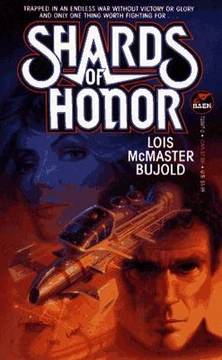
- Barrayar, Shards of Honor, and other saga novels
Lore & Background
Before the Civil War, Barrayar's many worlds were governed by hereditary planetary governors who wielded near-sovereign power over their territories—raising armies, collecting taxes, and answering to the Emperor only in the most nominal sense. The central government in Vorbarr Sultana was, in practice, limited. When the governors collectively rose against the throne, the conflict that followed was less a single pitched battle than a grinding suppression of multiple planetary uprisings, fought across Barrayar's scattered worlds with the full weight of Imperial military doctrine brought to bear against regional forces. The Vorkosigan family, already a prominent military house, threw their full weight behind the Emperor. Their commanders led key operations that broke the governors' coordinated resistance, and their sacrifices during the war earned them a place in Barrayaran history as the house that saved the state. In the aftermath, the Emperor restructured governance: the governors were reduced to administrative functionaries answerable directly to Vorbarr Sultana, and the Imperial military became the sole legitimate armed force across Barrayar. The old feudal balance was shattered, and a centralized, autocratic state emerged in its place. The war's legacy is felt in every subsequent novel. The political machinery Miles Vorkosigan must maneuver through—the loyalty oaths, the court intrigues, the Emperor's absolute authority, the suspicion of any house that might harbor independent power—all trace back to the logic of the Civil War. The Barrayaran state is, in a very real sense, the scar tissue of that conflict, and the Vorkosigan family's prestige is the scar's most visible mark.
In Their Own Story
The briefing room smelled of cold coffee and older blood. Captain Vorkosigan stood before the holo-table, his fingers tracing the orbital positions of the governor's fleet over Koudia, and said nothing for a long moment. The younger officers waited. He had seen what a governor's army could do when it was desperate and local—when every soldier knew the terrain, when the supply lines ran through villages that would rather starve than surrender. He had also seen what an Imperial column could do when it did not care about the villages. "We do not negotiate," he said at last, and the silence that followed was not agreement. It was the sound of men setting down their doubts and picking up their orders. Outside, the sky over Vorbarr Sultana was the flat, iron grey of a world that had decided, forty years ago, that it would not be divided again. The decision had cost a generation. The next generation would simply inherit the bill.
Reader's Guide
The Barrayaran Civil War is presented in the novels as established history, roughly four decades before the main narrative. It is referenced in *Barrayar* (1986) as the foundational event that explains why the Vorkosigan family holds such prestige and why the planetary governors are politically neutered. *Shards of Honor* (1987) and subsequent novels treat it as common knowledge among Barrayaran officers and courtiers. What the text states: the governors rebelled; the Imperial military suppressed the uprising; the Vorkosigan family was a key loyalist force; the result was centralized Imperial authority. What is fan-inferred: the specific sequence of battles, the identity of every rebel governor, and the precise military campaigns are left largely to the reader's imagination. The books give us the outcome and the political logic, not a play-by-play. Why it matters to the present-day plot: the entire power structure Miles Vorkosigan, Droushnakovi, and their allies must navigate—Imperial absolute monarchy, the suspicion of independent military power, the Vorkosigan family's elevated but precarious position—exists because of this war. Every loyalty oath, every court intrigue, every whispered fear of another governor rising is an echo of the Civil War. It is the reason Barrayar is the place it is, and the reason the Vorkosigans are who they are.
Did You Know?
- The Civil War is the in-universe explanation for why Barrayar's planetary governors are politically impotent by the time of the main novels—they were deliberately stripped of autonomous power after the rebellion.
- The Vorkosigan family's military prestige and their close relationship with the throne are explicitly tied to their role as Imperial loyalists during the war, making their later political vulnerabilities a direct consequ
- The war is never depicted in real time in any of the novels; it is always referenced as historical backstory, which means readers piece together its shape from scattered mentions across multiple books.
- The centralized, autocratic structure of Barrayaran government that so constrains Miles Vorkosigan's career is, in the books' logic, directly engineered as a post-war measure to prevent any future gubernatorial rebellion
The Isolation and Reconnection
Barrayar's history is defined by a catastrophic severance from the wider galaxy. After initial colonization, the planet's original wormhole collapsed—a rare event that plunged Barrayar into what is called the Time of Isolation. During this prolonged period of disconnection, the population suffered from low genetic diversity, and the apparent aftermath of nuclear warfare left vast stretches of the surface too radioactive for habitation. When Barrayar was eventually rediscovered through a wormhole jump originating from Komarr, the reconnection did not heal the wounds of isolation; instead, it set the stage for further conflict. The planet's native flora contained mutagenic compounds that, combined with the genetic bottlenecks of the isolation era, bred a deep cultural dread of mutation. This fear calcified into a pervasive xenophobia that continues to shape Barrayaran society's relationship with outsiders and with the broader galactic community. The isolation was not merely a logistical inconvenience but a formative trauma that defined Barrayar's identity as a closed, self-referential civilization.
A Society Forged in Fear
The social architecture of Barrayar stands in deliberate contrast to the rest of the galaxy. Where the Beta Colony and broader galactic society are characterized by egalitarianism and technological abundance, Barrayar operates as a hierarchical, militaristic civilization in which personal relationships are the glue that holds societal continuity together. This tension is not merely political; it is existential. The planet's history of nuclear devastation, genetic scarcity, and exposure to mutagenic native plants produced a cultural phobia of mutation so entrenched that it manifests as deep-seated xenophobia. Bujold uses this contrast to explore how a society's relationship with difference—whether biological, cultural, or political—can become a matter of survival. The saga's protagonist, Miles Vorkosigan, embodies this divide literally: his mother is a Betan former ship captain, his father a Barrayaran aristocrat. His very existence straddles the two worlds, making him a living negotiation between egalitarian openness and hierarchical tradition.
Wormholes and War
The politics of the Vorkosiverse are inextricable from the physics of interstellar travel. Jumping between solar systems relies on spatial anomalies—wormholes that create tunnels through five-dimensional space—and these chokepoints become instruments of power. Barrayar's original wormhole collapsed, triggering the Time of Isolation, but the planet's later rediscovery via a jump from Komarr opened a vulnerability that the neighboring Cetagandan empire exploited. Komarr permitted the Cetagandans to use their wormhole to conquer Barrayar, and the planet was later conquered in its own right when Barrayar ultimately defeated the Cetagandans. Military technology in this world is detailed and varied: ship-to-ship combat employs plasma rays and gravity-manipulation attacks, while personal warfare features combat suits, needlers, and nerve disruptors that destroy neural tissue. Biological weapons—wide-spectrum toxin bombs and genetically modified microbes targeting specific races or individuals—add a darker dimension. A truth serum called fast-penta is a standard interrogation tool, though several countermeasures exist, from induced fatal allergies to genetic immunity.
Voices Across the Divide
The Vorkosigan Saga, spanning from 1986 to May 2018, is notable for the breadth of its point-of-view characters, a range that enriches the Barrayaran political landscape with multiple perspectives. Women anchor several narratives—Cordelia in the early novels, Ekaterin in the Komarr and Vashnoi stories—while a gay man, Ethan of Athos, provides yet another lens. The Vorkosigan brothers themselves represent a study in difference: Miles is physically disabled, Mark is a clone, and their cousin Ivan Vorpatril offers a third generational viewpoint. Supporting figures like Miles's bodyguard Roic, family friend Kareen Koudelka, and the runaway Jin add texture to the world. The series has earned five Hugo Awards, including one for Best Series, a testament to the depth of its storytelling. Bujold grounds her speculative technology in 20th-century engineering projected into null-gravity or alternative planetary settings, and she acknowledges that her universal timekeeping system is a narrative convenience rather than a technologically feasible model. This blend of grounded science and sweeping political drama gives the saga its distinctive weight.
Frequently Asked Questions
What is the Barrayaran Civil War?
It was a rebellion led by the planetary governors against the central Imperial government, ultimately crushed by Imperial loyalist forces. The conflict established the centralized autocratic state that defines Barrayar throughout the Vorkosigan Saga.
When did the Barrayaran Civil War take place?
The war occurred roughly forty years before the events of Barrayar, the first novel in the saga. It is never depicted directly on the page but is referenced as a formative historical event by multiple characters across the books.
What role did the Vorkosigans play in the Barrayaran Civil War?
The Vorkosigan house threw its full military weight behind the Emperor's side, paying a heavy price in blood to secure the Imperial victory. That loyalty is what earned them the status of the Emperor's most trusted and powerful house for the following generation.
What was the outcome of the Barrayaran Civil War?
The Imperial government won decisively, and the planetary governors were stripped of their autonomy and local military authority. This created the rigid, top-down political structure that every character in the saga must navigate, resist, or exploit.
How does the Barrayaran Civil War shape the rest of the Vorkosigan Saga?
The centralized state it produced is the political backdrop for every novel, from Barrayar through The Vor Game and beyond. The Vorkosigans' wartime sacrifice also created a generational debt of expectation, pressuring the family to remain the Emperor's foremost instrument.
More in Lore & History
Elsewhere in the Vorkosigan Saga universe
Spotted an error? Know more?
This is a living reference — every entry is fact-audited, and reader corrections feed straight into our audit queue. Suggest an edit · See this site's audit record