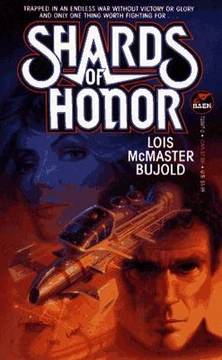
Gregor Vorbarra
The gentle heir who inherited an empire his grandfather forged in iron and silence.

Where his father projected cold, calculating authority, Gregor is defined by a gentler, more bookish temperament—almost an anachronism in a society built on military hierarchy and political ruthlessness. His eventual assumption of the throne represents one of the saga's quiet but profound shifts: Barrayar moving from the grip of a single iron will toward a more uncertain, human form of governance.
- Family position
- Grandson of Emperor Ezar Vorbarra, son of Prince Serg
Lore & Background
Gregor's character is best understood as a foil. Emperor Ezar ruled Barrayar with a precision and coldness that left little room for sentiment or compromise; his court was a machine of loyalty, surveillance, and calculated cruelty. Gregor, by contrast, is drawn to books, to quiet conversation, to the small mercies that his grandfather would have seen as weakness. In a culture where a ruler's worth is measured by the sharpness of his will, Gregor's gentleness reads as a kind of quiet rebellion—though one he never consciously wages. He simply is who he is, and the court must adapt around him rather than the other way around. His succession to the throne, following Ezar's death, is a moment of profound uncertainty for Barrayar. The counts and political factions who had navigated decades of Ezar's predictable, if terrifying, rule now face a ruler whose impulses are less legible. Gregor does not crush dissent with the same reflexive violence; he listens, he hesitates, he seeks counsel. This makes him both more vulnerable to manipulation and, paradoxically, more capable of the kind of political compromise that his grandfather could never have extended. The saga's later political threads—diplomatic missions, internal reform, the slow integration of Barrayar into wider interstellar politics—unfold under his watch, and the tone of governance shifts accordingly. Gregor also carries the private weight of being the son of Prince Serg, a man who was, by all accounts, a complex and often cruel figure. His relationship with his father's legacy is one of the saga's more emotionally resonant undercurrents: he must rule as a Vorbarra in a society that expects a Vorbarra to be a certain way, while quietly insisting that the throne can be occupied by a person rather than a function.
In Their Own Story
The study smelled of cold tea and old paper. Gregor sat with his back to the vast window, where the Barrayaran night pressed its dark weight against the glass, and turned a page of a history text he had been reading for three days without finishing. The candle guttered. Somewhere below, in the corridors of the palace, the boots of a courtier struck the stone in the measured rhythm of someone who had learned, years ago, not to hurry past the Emperor's door. He set the book down. Not because he was finished—far from it—but because the silence in the room had a particular quality, the kind that meant someone was waiting outside and would wait longer if he did not acknowledge them. He spoke a single word, soft, into the dark. The door opened. The courtier entered with the careful, measured grace of someone presenting a petition to a man who might, in a moment of sympathy, simply say yes. Gregor looked up. He did not reach for the seal, did not summon the guards, did not perform the cold arithmetic of power that his father had made his own. He simply listened. And in the listening, Barrayar held its breath and waited to learn what kind of emperor it had.
Reader's Guide
In the early Barrayaran novels, Gregor exists largely in the shadow of his father. He is the heir, the eldest son, the one who will inherit—but the political engine of the saga is driven by Ezar's will and the ambitions of the counts who orbit it. Gregor's presence is felt more as a future than a present, a question mark at the end of every power calculation. The succession itself—Ezar's death and Gregor's assumption of the throne—arrives as a turning point that reshapes the political texture of Barrayar. The counts who had spent years reading Ezar's every gesture now find themselves facing a ruler who pauses, who asks questions, who might say no for reasons of conscience rather than strategy. This is both a relief and a danger: a gentle emperor is easier to flatter, harder to predict, and more vulnerable to those who know how to manipulate uncertainty. In the later arcs, Gregor is the established sovereign under whom Barrayar navigates its place in the wider interstellar community. Diplomatic missions, internal political maneuvering, and the slow work of reform all unfold in his reign. The Vorbarra court, once a fortress of suspicion, becomes something more like a working government—imperfect, still hierarchical, but capable of the kind of compromise that characterizes the saga's later political threads. Foreshadowing from the early books—Ezar's private doubts, the court's fear of succession, the counts' calculations about which heir would be more malleable—find their payoffs here, as Gregor's reign either confirms or subverts the expectations his father's court had built around him.
Did You Know?
- Gregor's character is deliberately constructed as a thematic counterweight to Emperor Ezar: where Ezar embodies cold, efficient authority, Gregor embodies the uncertain, humane cost of ruling a society that glorifies str
- His succession is one of the saga's most consequential quiet moments—no battle, no coup, just the slow, terrifying shift of a political culture adjusting to a different kind of ruler.
- Gregor's bookish, contemplative nature makes him a rare Vorbarra who is defined more by what he thinks than by what he commands, a small but significant crack in the family's public image.
- The political factions of Barrayar that spent decades reading Emperor Ezar's every move find that Gregor's gentleness is, in some ways, harder to navigate than his father's cruelty, because it is less predictable.
Frequently Asked Questions
Who is Gregor Vorbarra?
Gregor is the eldest son of Emperor Ezar Vorbarra and the man who ultimately takes the Barrayaran throne, first appearing in Lois McMaster Bujold's 1991 novel *Barrayar*. He is a member of the Vorbarra Imperial House and, by the later books, the ruling sovereign of Barrayar.
What is Gregor Vorbarra's role in the Vorkosigan Saga?
He is the Emperor of Barrayar, the political figure around whom much of the saga's Barrayaran intrigue and diplomacy orbits. His reign marks a thematic turning point: Barrayar slowly loosens the grip of one iron will and stumbles toward a more collaborative, uncertain style of rule.
How does Gregor Vorbarra's story end?
Gregor survives the political crises of the later novels and continues to sit on the throne, balancing the Vorbarra crown against the growing weight of the Vor military house. His arc resolves less with a dramatic climax than with the ongoing, imperfect work of governing a society still adjusting to life after its founder's shadow.
Why is Gregor Vorbarra important to the saga?
He personifies the central question of whether Barrayar can outgrow the dominance-and-fear model its founding emperor established. His gentle, scholarly temperament forces the narrative to confront what an empire looks like once the myth of the single, unassailable ruler is set aside.
How does Gregor Vorbarra compare to his father, Emperor Ezar?
Ezar ruled through detached menace and an almost inhuman command of political violence, whereas Gregor leans toward reflection, literature, and a reluctance to wield cruelty as a tool of statecraft. That contrast is the emotional engine behind the saga's Barrayaran arcs, highlighting how one family's temperament reshapes an entire culture's expectations of power.
More in Story & Timeline
Related in Vorkosigan Saga
Links follow this subject's own source article.
Elsewhere in the Vorkosigan Saga universe
Spotted an error? Know more?
This is a living reference — every entry is fact-audited, and reader corrections feed straight into our audit queue. Suggest an edit · See this site's audit record